

Black Hole Imager
See a spinning black hole as it would really look: every pixel is a light ray traced through the Kerr spacetime, with frame dragging, Doppler and gravitational shifts, an accretion disk and your own 3D objects.
17 views0 favorites
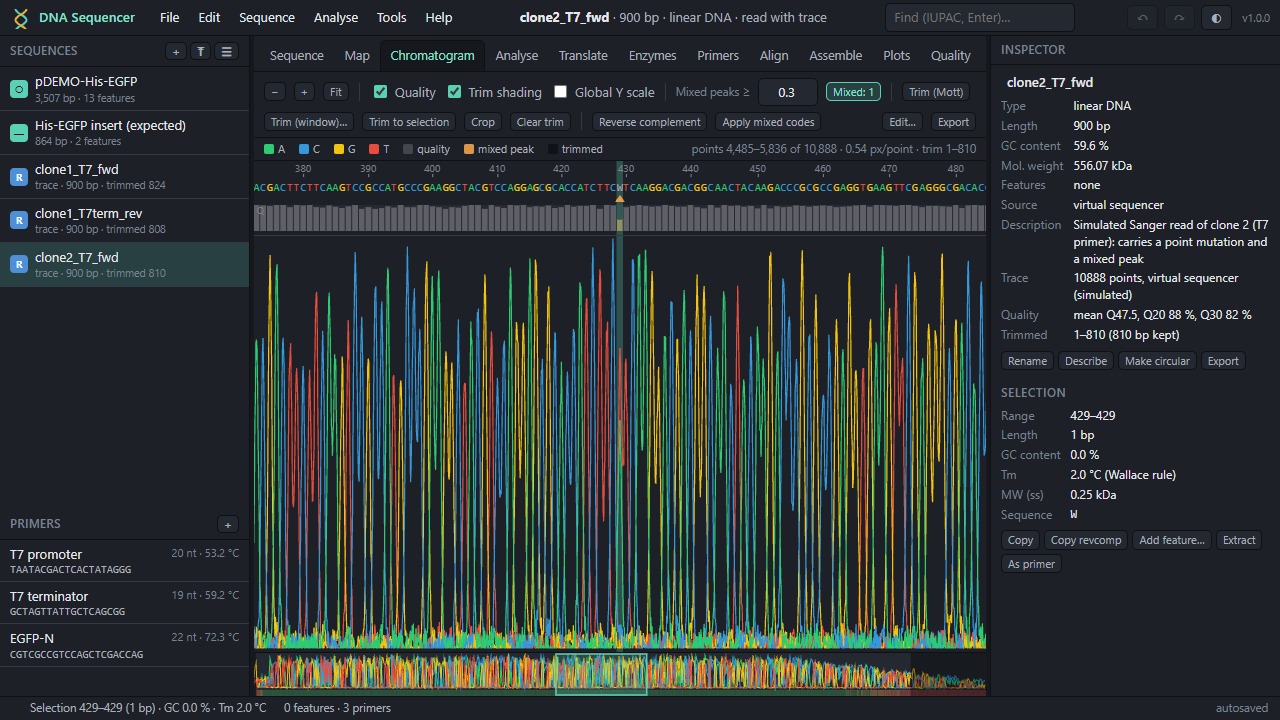
The sequence workbench for the bench: open .ab1 chromatograms and FASTQ/FASTA/GenBank files, trim and edit reads, assemble contigs, align to a reference and list every variant with its effect on the protein, annotate plasmids, plan digests and primers, print the gel – all in the browser, nothing uploaded.
Runs in your browser – nothing to install.
DNA Sequencer covers everything between "the run is finished" and "the construct is verified and documented". Drop Sanger .ab1 files onto the page: the chromatogram tab shows the four traces with base calls and quality values, trims the usable part (Mott or sliding window), flags mixed peaks (heterozygous positions, mixed clones) and lets you correct a base by hand. Reads are assembled into contigs with a quality-weighted consensus, and any read or consensus can be aligned to the expected sequence: every difference appears as a variant with its effect on the coding sequence (silent, missense, nonsense, frameshift), one click away from the trace at that base.
The sequence viewer shows ruler, both strands, translation frames, features and cut sites and lets you select, copy, edit and annotate. Analyse (composition, weights, Tm, motifs, repeats, CpG islands), Translate (six frames, ORFs for any NCBI genetic code, codon usage, protein properties, back-translation), Enzymes (restriction map of ~190 enzymes, digests, fragment sizes and a virtual agarose gel), Primers (nearest-neighbour Tm, hairpins and dimers, primer design, in-silico PCR, primer walking, universal primer sites), Map (circular or linear plasmid map as SVG/PNG), Plots (GC profile and skew, quality, hydropathy, dot plot) and Quality (bulk trimming, FASTQ statistics). Auto-annotation recognises promoters, terminators, operators, origins, recombination sites, resistance genes, reporters, tags and protease sites.
Verify a clone in one click: every read is oriented, trimmed and aligned to the expected sequence, with the coverage, the uncovered parts and each difference counted across the reads (a change in every read is real, one in a single read is a read error or a mixed clone). The cloning simulator digests a vector and an insert with your enzymes, checks the ends, ligates in the fitting orientation, carries the features of both parents into the product and tells you whether the sites are regenerated. Codon optimisation re-encodes a CDS for E. coli, human, CHO, yeast or Pichia and avoids the sites you name.
A virtual sequencer produces realistic chromatograms from any template (primer or position, read length, error rate, heterozygous sites) and exports them as .ab1 – for testing, teaching or demo data. Import FASTA, FASTQ, GenBank, EMBL, plain text and ABIF; export FASTA, FASTQ, GenBank and EMBL with features, CSV tables, SVG/PNG pictures, .ab1 traces, a printable report and a project file that holds everything. The project is also autosaved in the browser. Nothing leaves your computer: this tool has no cloud saves and no account.
No comments yet.
See a spinning black hole as it would really look: every pixel is a light ray traced through the Kerr spacetime, with frame dragging, Doppler and gravitational shifts, an accretion disk and your own 3D objects.
Launch particles, light rays and spaceships around a spinning black hole – orbits, light bending, frame dragging and time dilation.
An interactive 2D gravity simulator: planets, binary stars, asteroid belts and colliding galaxies with real physics.
Do prime numbers hide a pattern in base 3? A live laboratory that tests the idea with exact computation, controlled statistics and the zeros behind the primes.


Log in to write a comment or reply. A moderator checks every comment before it appears – for security and to keep spam and abuse out.